
Introduction
Every successful program—whether in IT, business transformation, compliance, or operations—follows a structured journey from idea to completion. This journey is known as Program Life Cycle Management (PLCM). Understanding this lifecycle helps organizations deliver outcomes on time, within budget, and aligned with business goals.
Program Life Cycle Management provides a clear framework to plan, execute, monitor, and close programs effectively. It ensures better coordination, risk control, and value delivery across multiple projects working toward a common objective.
What Is Program Life Cycle Management?
Program Life Cycle Management is the structured process used to manage a program from initiation to closure. Unlike project management, which focuses on individual deliverables, program management oversees multiple related projects to achieve strategic benefits.
PLCM helps organizations maintain control, ensure alignment with objectives, and continuously track performance throughout the program’s lifespan.
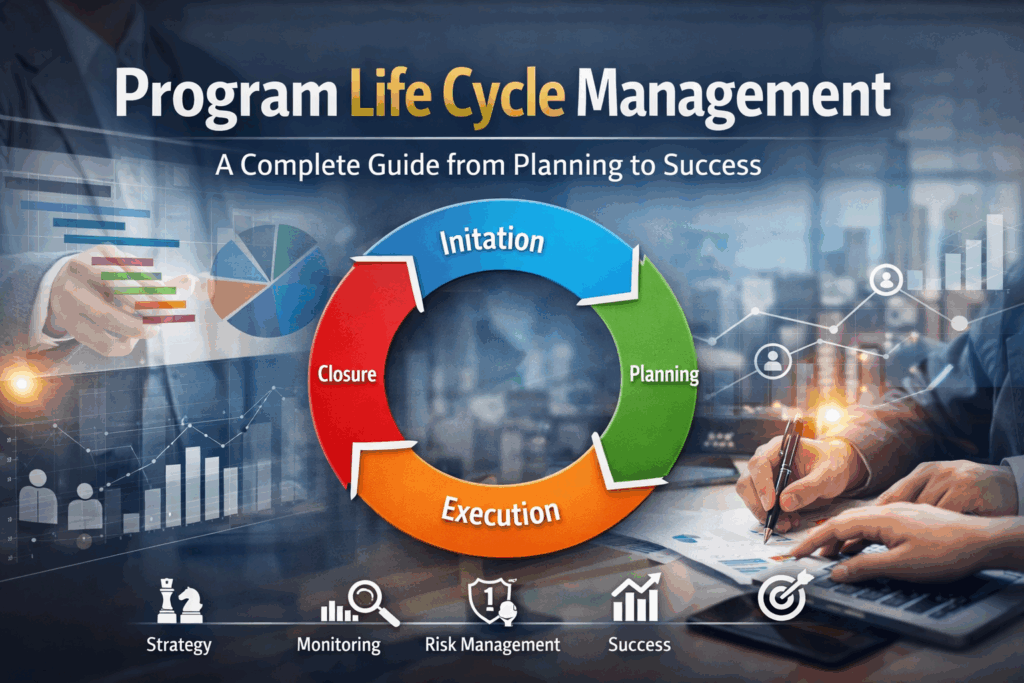
Key Phases of Program Life Cycle Management
1. Program Initiation
This is where the foundation is built. Business needs are identified, objectives are defined, and feasibility is assessed. Key stakeholders are engaged, and the program vision is established.
Outcome: Approved program charter and clear strategic alignment.
2. Program Planning
In this phase, detailed planning takes place. This includes defining scope, timelines, budgets, risk strategies, governance structures, and communication plans.
Outcome: A well-defined roadmap that guides execution.
3. Program Execution
Execution involves coordinating multiple projects, managing resources, resolving dependencies, and ensuring collaboration across teams. Continuous stakeholder communication is critical here.
Outcome: Projects deliver outputs while staying aligned with program goals.
4. Program Monitoring and Control
This phase runs parallel to execution. Performance is tracked using KPIs, risks are managed, and corrective actions are taken when needed. Benefits realization is closely monitored.
Outcome: Controlled progress with minimized risks and optimized performance.
5. Program Closure
Once objectives are met, the program is formally closed. Deliverables are reviewed, lessons learned are documented, and benefits are transitioned to business operations.
Outcome: Sustainable value and organizational learning.
Why Program Life Cycle Management Matters
- Improves alignment with business strategy
- Enhances risk and dependency management
- Ensures better resource utilization
- Increases transparency and accountability
- Maximizes long-term benefits realization
Organizations that follow PLCM are more likely to achieve consistent, predictable outcomes.
Who Should Learn Program Life Cycle Management?
- Program and project managers
- Business and IT leaders
- PMO professionals
- Compliance and operations managers
- Professionals preparing for leadership roles
Understanding PLCM is especially valuable for those managing complex initiatives across departments.
Conclusion
Program Life Cycle Management is not just a methodology—it’s a strategic approach to delivering real business value. By following a structured lifecycle, organizations can reduce uncertainty, improve coordination, and ensure programs deliver meaningful outcomes.
Whether you’re managing enterprise initiatives or preparing for advanced leadership roles, mastering Program Life Cycle Management is a powerful step toward long-term success.
Location: India, Bengaluru