
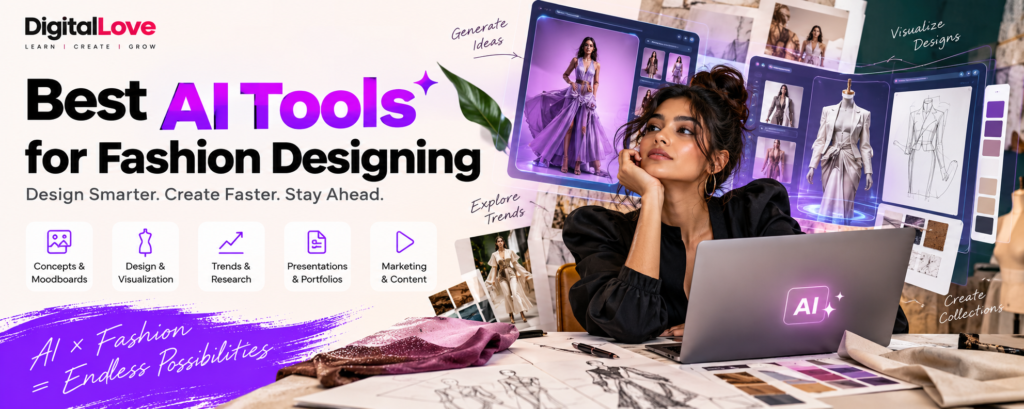
Best AI Tools for Fashion Designing : Design, Trends, Moodboards & More
Artificial Intelligence is changing the way fashion designers research trends, develop concepts, create moodboards, experiment with colors, visualize garments, and present new collections.
What once required hours of sketching, research, Photoshop work, and repeated sampling can now be accelerated with AI-powered tools.
Whether you are a fashion design student, aspiring designer, fashion entrepreneur, stylist, apparel professional, or creative freelancer, learning how to use AI can give you a significant advantage.
In this guide, we explore some of the best AI tools for fashion designing and explain how they can be used throughout the fashion-design process.
How AI Is Changing Fashion Designing
AI is not replacing the creativity of a fashion designer.
Instead, it can act as a creative assistant.
Designers can use AI to:
Generate fashion concepts
Create moodboards
Explore silhouettes
Experiment with colors
Generate prints and patterns
Visualize garments
Create fashion illustrations
Research trends
Develop collection concepts
Create marketing visuals
Produce social media content
Present ideas to clients and buyers
The biggest advantage is speed.
A designer can explore dozens of creative directions before selecting the strongest concept for further development.
1. Midjourney – AI Fashion Concept Generation
Best for: Fashion concepts, editorial visuals, moodboards and creative exploration
Midjourney is one of the most popular generative-AI platforms for creating highly visual concepts.
Fashion designers can use it to explore:
Couture concepts
Streetwear
Luxury fashion
Avant-garde designs
Editorial photography
Fashion styling
Accessories
Color palettes
Collection themes
For example, a designer could create a prompt such as:
“Contemporary Indian couture collection inspired by architectural forms, structured silhouettes, metallic detailing, editorial fashion photography.”
The resulting concepts can help the designer explore visual directions before creating final designs.
Why fashion designers may find it useful
Instead of starting with a completely blank page, AI can provide multiple visual directions that can be refined through human creativity.
2. Adobe Firefly – AI for Creative Fashion Workflows
Best for: Image generation, editing, backgrounds, concepts and creative production
Adobe Firefly can be useful for designers who already work within the Adobe ecosystem.
It can help with tasks such as:
Generating visual concepts
Editing images
Creating backgrounds
Removing or replacing objects
Exploring different visual styles
Creating marketing assets
For fashion students, this can be particularly useful when developing presentations, portfolios and campaign concepts.
A designer might photograph a garment and use AI-assisted editing to explore different environments, lighting styles or campaign directions.
3. CLO 3D – Digital Garment Design & Visualization
Best for: 3D garment development and virtual sampling
CLO 3D is particularly valuable for designers who want to move beyond 2D sketches and work with digital garments.
Designers can create and visualize garments in a 3D environment before producing physical samples.
This can help with:
Garment construction
Fabric visualization
Fit experimentation
Digital sampling
Pattern development
3D presentations
Virtual fashion concepts
One major advantage of digital garment development is the ability to test ideas before committing resources to physical samples.
4. Style3D – 3D Fashion Design & Virtual Garments
Best for: Digital fashion, 3D garment visualization and virtual sampling
Style3D provides tools for creating and visualizing digital garments.
It can be useful for designers working on:
3D apparel
Virtual collections
Digital sampling
Garment visualization
Fashion presentations
Product development
As fashion brands increasingly experiment with digital workflows, 3D design skills are becoming increasingly valuable.
5. Canva AI – Fashion Presentations & Marketing
Best for: Moodboards, presentations, portfolios and social media
Canva is not exclusively a fashion-design platform, but its AI-powered creative tools can be extremely useful for fashion students and designers.
You can use it to create:
Fashion moodboards
Collection presentations
Portfolio pages
Instagram posts
Fashion campaign concepts
Brand presentations
Lookbooks
Marketing materials
For a student building a fashion portfolio, Canva can help transform individual designs into a polished visual presentation.
6. ChatGPT – Fashion Research, Ideas & Creative Development
Best for: Research, brainstorming, collection concepts, descriptions and planning
AI can also be useful before the actual designing begins.
ChatGPT can help fashion designers brainstorm:
Collection themes
Customer personas
Fashion trends
Design concepts
Color stories
Collection names
Garment descriptions
Brand stories
Product descriptions
Social media ideas
Fashion-business strategies
For example, a designer could ask AI:
“Develop five fashion collection concepts inspired by Indian architecture for Gen Z consumers.”
The designer can then select the strongest idea and develop it visually.
The important point is that AI provides possibilities; the designer decides which ideas actually make sense creatively.
7. Pinterest + AI-Assisted Research
Best for: Inspiration, visual research and trend discovery
Pinterest remains an important source of visual inspiration for fashion designers.
Designers can research:
Silhouettes
Textures
Fabrics
Color combinations
Styling
Accessories
Streetwear
Bridal fashion
Interior-inspired fashion
Historical references
AI can then help organize and interpret research.
For example, a designer could collect hundreds of references and use AI to identify recurring themes such as:
Colors → Shapes → Materials → Consumer → Mood → Styling
This can turn inspiration into a more structured design direction.
8. Figma AI – Fashion Presentation & Concept Boards
Best for: Digital design systems, presentations and collaborative projects
Figma is particularly useful when fashion projects involve digital presentations, websites, brand identity or collaborative creative work.
Fashion businesses can use it to develop:
Brand concepts
Digital lookbooks
Website layouts
Campaign concepts
Product presentation systems
Collaborative moodboards
For fashion entrepreneurs building a digital-first brand, design collaboration can be just as important as garment creation.
9. Runway – AI Video for Fashion Campaigns
Best for: Fashion videos, campaign concepts and social content
Fashion is increasingly visual and video-driven.
AI video tools such as Runway can help designers and fashion brands experiment with:
Campaign videos
Fashion films
Product storytelling
Social media videos
Editorial concepts
Visual effects
Imagine taking a still fashion concept and turning it into a short campaign sequence.
This can be especially useful for fashion brands that need frequent content for Instagram, YouTube Shorts and other platforms.
10. DALL·E / AI Image Generation Tools
Best for: Rapid visual ideation
AI image-generation tools can help designers explore ideas quickly.
For example:
“Minimalist luxury resortwear collection using flowing silhouettes, natural textures and neutral colors.”
A designer can generate several interpretations and use them as references for further creative development.
The output should be treated as conceptual inspiration, rather than automatically becoming the final garment.
Which AI Tool Should Fashion Students Learn First?
You don’t need to learn every AI tool.
A practical learning path could look like this:
| Fashion Task | Useful AI Tool Type |
|---|---|
| Fashion research | AI + Pinterest |
| Collection ideas | ChatGPT |
| Moodboards | Canva / AI image tools |
| Visual concepts | Midjourney / image generators |
| Image editing | Adobe Firefly |
| 3D garments | CLO 3D / Style3D |
| Fashion presentations | Canva / Figma |
| Fashion videos | Runway |
| Marketing content | ChatGPT + Canva |
| Product descriptions | ChatGPT |
The most powerful approach is not choosing one AI tool.
It is learning how different tools work together.
How to Build an AI-Powered Fashion Design Workflow
A modern fashion designer could follow a workflow like this:
Step 1: Research
Start by researching the target customer, market, competitors, cultural references and emerging trends.
Step 2: Generate Ideas
Use AI to brainstorm collection themes, concepts, silhouettes and styling directions.
Step 3: Create a Moodboard
Combine references, colors, textures, architecture, photography and AI-generated concepts.
Step 4: Develop the Designs
Turn the strongest concepts into actual sketches and garment designs.
Step 5: Experiment Digitally
Use 3D fashion software to explore garment construction, fit and visualization.
Step 6: Refine
Use human design judgment to select the strongest concepts and improve the details.
Step 7: Create the Presentation
Build a professional portfolio, lookbook or collection presentation.
Step 8: Market the Collection
Use AI-assisted tools to develop campaign concepts, social media content, product descriptions and promotional visuals.
AI Is a Tool — Creativity Still Matters
There is an important distinction between using AI and letting AI design everything.
A successful fashion designer still needs to understand:
Design principles
Color theory
Fabrics
Textiles
Garment construction
Silhouettes
Consumer behavior
Fashion history
Styling
Trend analysis
Brand positioning
AI can accelerate the process, but the designer provides the creative direction.
The strongest future fashion designers will likely be those who combine traditional fashion knowledge with modern AI capabilities.
What Should Fashion Design Students Learn in AI Tech Age ?
If you are planning a career in fashion design, don’t limit your learning to traditional design software.
Consider developing a combination of:
Fashion Design + AI Tools + Digital Design + 3D Visualization + Branding + Social Media
This combination can open opportunities beyond traditional fashion-design roles.
You could work toward careers such as:
Fashion Designer
Fashion Illustrator
Digital Fashion Designer
3D Fashion Designer
Fashion Stylist
Fashion Visual Designer
Fashion Brand Strategist
Fashion Content Creator
Fashion Marketing Specialist
Fashion Entrepreneur
Final Thoughts
AI is rapidly becoming another creative tool in the fashion designer’s toolkit.
The future isn’t necessarily AI vs. designers.
It is more likely to be designers who use AI vs. designers who don’t.
The designers who understand how to combine creativity, fashion knowledge, technology and AI will have more ways to experiment, visualize and communicate their ideas.
If you’re starting your fashion-design journey today, learning AI alongside core fashion-design skills can give you a valuable competitive advantage.
Learn fashion. Learn technology. Learn AI. Create what’s next.
Want to Learn AI for Fashion Design?
At DigitalLove Academy, we believe the next generation of creative professionals should understand both design and technology.
Explore our fashion-design learning programs and discover how AI tools can be incorporated into your creative workflow.
