Digital marketing is no longer a single skill. It combines SEO, paid advertising, social media, content marketing, analytics, AI, CRM, email marketing and conversion optimization.
That is why choosing a digital marketing course should depend on who you are, what you want to learn, and how much time you can invest.
A student looking to build a long-term career may benefit from a comprehensive program, while a working professional may need a shorter, focused course that can immediately strengthen an existing skill set.
Instead of choosing one course for everyone, a better approach is to choose the right digital marketing program for the right audience.
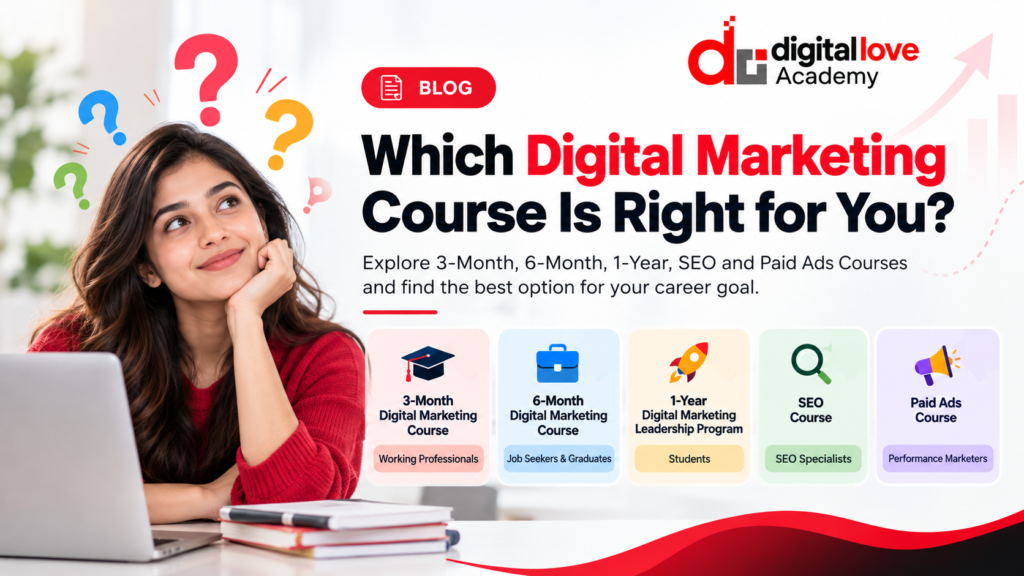
Which Digital Marketing Course Is Right for You?
| Course | Ideal For | Duration | Main Objective |
|---|---|---|---|
| 3-Month Digital Marketing Course | Working professionals, freelancers, entrepreneurs | 3 Months | Fast practical skills |
| 6-Month Digital Marketing Course | Graduates, job seekers, career changers | 6 Months | Job-ready digital marketer |
| 1-Year Digital Marketing Leadership Program | Students & aspiring marketing leaders | 1 Year | Advanced career & leadership |
| SEO Course | SEO specialists, website owners, freelancers | Short-term | Become an SEO specialist |
| Paid Ads Course | Performance marketers, sales professionals, entrepreneurs | Short-term | Google & Meta advertising |
3-Month Digital Marketing Course
Best for: Working Professionals, Freelancers & Entrepreneurs
Not everyone needs a year-long program.
If you’re already working or running a business and want to develop practical digital marketing skills quickly, a 3-month program can be a suitable option.
What you can learn
- Digital marketing fundamentals
- SEO fundamentals
- Google Ads
- Meta Ads
- Social media marketing
- Content marketing
- Google Analytics
- Lead generation
- Landing pages
- AI tools for marketing
- Campaign reporting
Who should choose this course?
Working professionals who want to add digital marketing to their existing role.
Entrepreneurs who want to understand and manage their online marketing.
Freelancers who want to start offering digital marketing services.
Sales professionals who want to understand online lead generation.
Why choose a shorter program?
The objective isn’t to learn everything. It is to develop practical, immediately usable skills.
6-Month Digital Marketing Course
Best for: Graduates, Job Seekers & Career Changers
If you’re serious about starting a career in digital marketing, a 6-month program can provide more time for structured learning and practical projects.
Instead of simply learning individual tools, students can understand how different marketing channels work together.
Core areas
Digital Marketing Strategy
Understanding customers, competitors, funnels and campaign objectives.
SEO
Keyword research, on-page SEO, technical SEO, local SEO, content optimization and analytics.
Paid Advertising
Google Ads, Meta Ads, campaign structures, targeting, conversion tracking and optimization.
Social Media
Content planning, community management, paid campaigns and social analytics.
Content Marketing
Blogs, social content, landing pages, videos and AI-assisted content workflows.
Analytics
Google Analytics, Search Console, campaign reporting and marketing KPIs.
Lead Generation
Landing pages, forms, conversion optimization and lead nurturing.
AI for Digital Marketing
Using AI for research, content creation, campaign planning, analysis and productivity.
Who should choose the 6-month course?
- Graduates
- Final-year students
- Job seekers
- People changing careers
- Junior marketing professionals
- People returning to the workforce
The longer duration allows more time for projects, assignments, portfolio development and practical campaign experience.
1-Year Digital Marketing Leadership Program
Best for: Students & Future Marketing Leaders
Students who want to make digital marketing their primary career may benefit from a longer-term program.
A one-year program should go beyond learning individual tools and focus on strategy, execution, analytics, business understanding and leadership.
What could the program cover?
Foundation
- Digital marketing fundamentals
- Marketing strategy
- Consumer behaviour
- Branding
- Content marketing
Performance Marketing
- Google Ads
- Meta Ads
- LinkedIn Ads
- Remarketing
- Conversion optimization
- Lead generation
Organic Growth
- SEO
- Local SEO
- Technical SEO
- Content strategy
- Organic social media
Technology
- Analytics
- CRM
- Marketing automation
- AI tools
- Landing pages
- Conversion tracking
Business & Leadership
- Marketing budgets
- ROI measurement
- Marketing dashboards
- Client management
- Team management
- Campaign planning
- Marketing strategy
- Agency management
Why is a one-year program different?
A student has more time to learn → practice → make mistakes → receive feedback → execute projects → build a portfolio.
For someone entering digital marketing immediately after graduation, this longer learning journey can provide broader exposure than a short-term tool-focused course.
SEO Course
Best for: SEO Specialists, Freelancers, Website Owners & Content Professionals
Not everyone needs to become a full-stack digital marketer.
If your specific goal is organic search growth, an SEO-focused course may be more appropriate.
Topics can include:
- Keyword research
- On-page SEO
- Technical SEO
- Local SEO
- Content SEO
- Link building
- Google Search Console
- SEO analytics
- Website audits
- AI-assisted SEO
- SEO reporting
Ideal audience
- SEO beginners
- Freelancers
- Bloggers
- Website owners
- Content writers
- Digital marketers
- Small-business owners
Paid Ads Course
Best for: Performance Marketers, Entrepreneurs & Sales Professionals
If your goal is to generate leads or sales through advertising, a focused Paid Ads Course can be more relevant than a broad digital marketing program.
Google Ads
- Search campaigns
- Performance Max
- Display advertising
- Remarketing
- Keyword targeting
- Conversion tracking
- Campaign optimization
Meta Ads
- Facebook advertising
- Instagram advertising
- Audience targeting
- Lead generation
- Retargeting
- Creative testing
- Campaign optimization
Ideal audience
- Performance marketing beginners
- Sales professionals
- Entrepreneurs
- Freelancers
- Digital marketing executives
- Business owners
Which Course Should a Student Choose?
For a student, the objective should generally be broader skill development rather than learning one advertising platform.
Recommended learning path
1-Year Digital Marketing Leadership Program
↓
Learn fundamentals
↓
Master SEO + Paid Ads + Social Media + Content
↓
Learn Analytics + CRM + AI
↓
Work on live projects
↓
Build portfolio
↓
Develop leadership & business skills
↓
Prepare for career
A longer program gives students more time to develop a broader professional foundation.
Which Course Should a Working Professional Choose?
Working professionals usually have a different requirement.
They may already have experience in sales, marketing, HR, business development, IT or management.
Instead of spending a year learning everything from the beginning, they may want a focused 3-month program.
For example:
Sales Professional → Paid Ads + Lead Generation
Content Writer → SEO + Content Marketing
Business Owner → Digital Marketing + Lead Generation
Marketing Executive → Performance Marketing + Analytics
HR Professional → LinkedIn + Personal Branding
The course should match the professional’s existing experience.
What About Someone Looking for a Job?
For a graduate or career changer, a 6-month program can provide a middle path.
It can provide enough time to learn multiple channels while developing practical projects and a portfolio.
The focus should be:
Learn → Practice → Build → Demonstrate
rather than simply:
Watch videos → Take exam → Receive certificate.
Don’t Choose a Course Only by Duration
A 12-month course isn’t automatically better than a 3-month course.
Likewise, a 3-month course isn’t necessarily enough for everyone.
The right duration depends on the learner.
Student
Long-term learning → 1-year program
Graduate / Job Seeker
Career preparation → 6-month program
Working Professional
Fast skill upgrade → 3-month program
Specialist
Specific skill → SEO or Paid Ads course
Business Owner
Business-focused digital marketing → Short practical program
The Right Course Depends on the Right Goal
Digital marketing education should move away from a “one course for everyone” approach.
Someone who wants to become an SEO specialist doesn’t necessarily need a one-year leadership program.
Someone who wants to build a long-term digital marketing career may need considerably more than a short SEO course.
And a business owner may simply need to understand how to generate leads, manage campaigns and measure marketing performance.
The best course is therefore the one that matches:
Your career stage + your available time + your existing skills + your professional goal.
A Practical Digital Marketing Learning Path
For someone starting from zero, a possible progression is:
Beginner → 6-Month Digital Marketing Course
Advanced → 1-Year Digital Marketing Leadership Program
Working Professional → 3-Month Digital Marketing Course
SEO Specialist → SEO Course
Performance Marketer → Paid Ads Course
Entrepreneur → Digital Marketing for Business Growth
This approach makes digital marketing education more focused, practical and career-oriented.
